
So… the Government Changed Everything
About Health Insurance.
Cool, Cool, Cool.
By Anne Glorioso, CEO · Solidarity Health Network, Inc. · Cleveland, Ohio
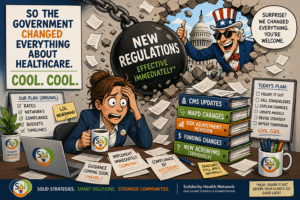
If you work in ACA (Affordable Care Act) compliance, you already know last summer was A Lot. And I mean A LOT. Two massive policy actions dropped within 40 days of each other and rewrote the rulebook for Marketplace health plans. We’re talking eligibility, enrollment, subsidies, Medicaid, HSAs (Health Savings Accounts), open enrollment windows — basically everything except the actual font on the application.
This post is for the compliance officers, carrier teams, and benefits nerds who lived through it. We’re not going to make you read a 30-page reg summary. We’re going to hit the big stuff, keep it moving, and let you go back to your regularly scheduled panic.
Who Gets In Just Changed — And Some of This Already Happened
DACA (Deferred Action for Childhood Arrivals) recipients are no longer eligible for Exchange coverage. Full stop, effective August 25, 2025. CMS (the Centers for Medicare & Medicaid Services) revised the definition of “lawfully present” — and DACA doesn’t make the cut anymore. Existing DACA enrollees got a 60-day Special Enrollment Period (SEP) to transition off-Exchange. If your enrollment systems and agent networks weren’t updated for this, that’s a problem that has already happened.
Issuers can now hold new coverage hostage to unpaid past-due premiums. The old rule said you couldn’t link new enrollment to unpaid prior balances. That rule is gone. States have to allow it and issuers have to opt in — but the tool is on the table. For plans with high turnover in their subsidized book, this is a meaningful new lever.
Agent and Broker Misconduct Finally Has Teeth
Remember the wave of fraudulent enrollments where agents were signing people up for plans without their knowledge? CMS does. That’s a big part of what drove these rule changes in the first place.
CMS formalized the framework for suspending and terminating agents and brokers who play games with enrollments. Here’s the part compliance officers need to hear: the downstream consequences land on the plan’s book of business, not just the rogue broker. If a bad agent enrolls a thousand people who never asked to be enrolled, that’s your claims liability, your risk pool, your headache.
Build agent-level compliance monitoring into your operations. Yesterday. (Not sure where to start? We’re covering exactly what that looks like in an upcoming post — stay tuned.)
Immigration Status and Subsidies: A Two-Year Phase-Out
This one has layers, and it matters for your book of business right now.
Here’s how the eligibility restrictions are rolling out:
- Plan Year 2026 (now): Lawfully present immigrants with income below 100% of the FPL (Federal Poverty Level) who don’t qualify for Medicaid due to their immigration status are ineligible for PTCs (Premium Tax Credits — the subsidies that make Marketplace plans affordable). They can still enroll — but without subsidy support, expect elevated lapses and non-payment in this segment.
- Tax Years after December 31, 2026: Only U.S. citizens, LPRs (Lawful Permanent Residents — green card holders), Cuban and Haitian entrants, and COFA (Compact of Free Association) migrants qualify for PTCs. Refugees, asylees, and many other lawfully present statuses that previously qualified? No longer eligible for subsidies. Plans with significant immigrant enrollment will feel this in their retention numbers.
So who actually tracks immigration status — you or CMS?
CMS and the federal Marketplace handle immigration status verification at the point of enrollment, checking applicants against federal DHS (Department of Homeland Security) databases. Carriers receive an EDI 834 enrollment transaction reflecting who has been cleared as eligible. You are not independently re-verifying immigration status on your end.
But here’s the operational problem you DO own: The phase-out is happening in steps. Members currently enrolled with subsidy support may lose that eligibility at renewal — or mid-year if their status changes — and suddenly find themselves owing full premiums. When that happens, they drop coverage. You will feel this in your revenue and your call center before CMS sends you a memo about it. If you have significant immigrant enrollment, model the composition of your book against the 2027 eligibility rules now. Don’t wait.
Open Enrollment Is Now a Sprint, Not a Marathon
Starting fall 2026, the OEP (Open Enrollment Period) for Plan Year 2027 runs November 1st through December 15th. That’s 45 days. Previously: 75 days.
Everything you built for OEP — member acquisition campaigns, call center staffing, agent engagement, digital enrollment workflows — needs to be redesigned for a compressed sprint. You are no longer training for a marathon. You are now doing a 40-yard dash in dress shoes.
The Subsidy Payback Cap Is Gone. Like…Gone Gone.
This is the one that’s going to generate member calls, member complaints, and member churn — all landing on your plate.
Previously, if a member received too much in APTC (Advance Premium Tax Credits — the monthly subsidy applied directly to premiums), there was a cap on how much they had to repay at tax time: roughly $325 to $1,650 depending on income. That cap is eliminated entirely for tax years beginning after December 31, 2025.
Now it’s full repayment. No ceiling. Members who underestimated their income are going to get hit with real IRS bills — and many of them will have no idea it’s coming until it does.
This is where carriers and plans have both a responsibility and an opportunity. CMS is not sending your members mid-year income nudges. You are. Or you should be. Build income update prompts into every member touchpoint — welcome packets, mid-year check-ins, life event communications, renewal outreach. Every single one.
The most exposed segments are gig workers, freelancers, commission-based earners, seasonal employees, and small business owners — anyone whose income is a moving target. These members are not thinking about subsidy reconciliation in July. Plans that build proactive outreach around income changes will reduce year-end churn and build real member trust. Plans that don’t will own the call volume when the IRS bills drop.
Enrollment Verification: Now They Have to Actually Prove It
Pre-enrollment verification is now required for SEPs on the federal platform. HHS (the Department of Health and Human Services) must verify at least 75% of new SEP enrollments before coverage begins. Faster enrollment is no longer the default. Build different effectuation timelines into your operational SLAs (Service Level Agreements).
Auto-reenrollment without active confirmation no longer carries full APTC. Members who are auto-renewed into a zero-premium plan without confirming their eligibility will now owe $5/month. Expect your call center volume during OEP to spike as members discover this.
Failure to file taxes now blocks APTC after just one year. Enrollees who received APTC in a prior year and failed to file IRS Form 8962 — the Premium Tax Credit reconciliation form — are blocked from future subsidies until resolved. The rule tightened from two years of non-filing to one. Plan for the call volume this generates and build it into your member communications calendar.
Medicaid Is About to Send You a Wave — Tell Your Actuaries
This one isn’t a compliance problem — it’s an actuarial one. But somebody in your building needs to be running the numbers, so consider this your nudge.
Starting Q1 2027, more than 22 million Medicaid expansion adults face redetermination every six months instead of annually, plus new work requirements. Experience from the COVID-era Medicaid unwinding tells us: even eligible people get dropped due to paperwork. Those people land on the Exchange as SEP activity. Retroactive Medicaid coverage also drops from three months to one month, meaning members arrive with longer gaps — and higher acuity.
If nobody on your team is modeling what that wave looks like for your market, now’s the time to ask.
Actually Good News: HSAs Just Got Way More Useful
Bronze and Catastrophic plans are now HSA (Health Savings Account)-eligible. Effective for plan months after December 31, 2025, these plans are formally treated as HDHPs (High Deductible Health Plans) for HSA purposes. This opens a meaningful product design opportunity — particularly for plans targeting younger, healthier market segments where low-premium, high-deductible structures are competitive.
The telehealth safe harbor for HSA-paired HDHPs is now permanent. Stop wondering whether this sunsets. It won’t. Build it into your product designs and member communications without hesitation.
DPC (Direct Primary Care) arrangements are now HSA-compatible. Monthly DPC fees up to $150 per individual — indexed for inflation — no longer disqualify HSA eligibility and can be paid directly from the HSA. Plans that have been exploring DPC partnerships just lost a major structural barrier. Now’s the time to revisit those conversations.
Key Dates Cheat Sheet
When |
What Changes |
| Aug 25, 2025 | DACA excluded from Exchange; past-due premium rule lifted; broker misconduct standards formalized |
| Plan Year 2026 | SEP pre-enrollment verification required; auto-reenrollment APTC confirmation; AV (Actuarial Value) de minimis adjusted; sex-trait modification removed from EHB (Essential Health Benefits) |
| Tax Year 2025 (filed in ’26) | APTC recapture cap eliminated — full repayment required, no ceiling |
| After 12/31/25 | Income-based SEP no longer PTC-eligible; Bronze/Catastrophic plans HSA-eligible; DPC HSA-compatible; telehealth safe harbor permanent |
| Oct 1, 2026 | Alien Medicaid eligibility restricted to qualifying immigration categories |
| Q1 2027 | Medicaid: 6-month redeterminations + work requirements + retroactive coverage cut to 1 month |
| Nov 1–Dec 15, 2026 | First shortened OEP — for Plan Year 2027. Permanent going forward. |
| Tax Years after 12/31/26 | PTCs restricted to “eligible aliens” only — LPRs, Cuban/Haitian entrants, COFA residents |
Want the full policy analysis?
We published a detailed version covering every provision, effective date, and operational implication for plan administrators and compliance teams. Email me and I’ll send it right over: aglorioso@shninc.org
Solidarity Health Network, Inc. · Cleveland, Ohio · www.shninc.org
TPA · ACA Administration · MAPD Consulting · Taft-Hartley Administrator · SOC 2 Type II Certified · HIPAA Compliant · 340,000+ Covered Lives
This post is for informational purposes only and does not constitute legal, actuarial, or regulatory advice.