SHN THOUGHT LEADERSHIP · SHNINC.ORG
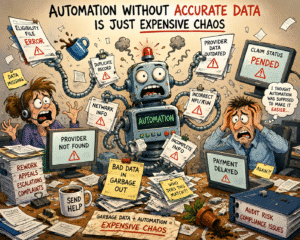
Automation Without Accurate Data
Is Just Expensive Chaos
By Anne Glorioso, CEO · Solidarity Health Network, Inc. · Cleveland, Ohio
 The healthcare industry is racing toward automation. And honestly? Good. It’s about time.
AI-powered claims systems. Electronic prior authorization. Real-time interoperability. Automated repricing. Predictive analytics. Smart provider matching. On paper, it sounds like someone finally figured out how to drag healthcare administration into the 21st century.
But here’s the part nobody puts in the press release:
Automation is only as good as the data feeding it. And right now, bad data is quietly breaking healthcare operations across the industry — while everyone stands around admiring the technology.
Everyone Wants to Automate. Not Everyone Is Ready.
The pressure to automate is real and it is coming from every direction. Lower costs. Faster turnaround. Less staffing pressure. Better member experience. Regulatory compliance. Nobody is arguing with the goal.
The problem is that a lot of organizations are trying to automate an unstable operational environment. And what that actually produces is a system that looks efficient on the surface while the failures pile up quietly underneath.
Think of it like putting a fresh coat of paint on a house with a bad foundation. It looks great until it doesn’t.
The Problem Nobody Wants to Admit
Healthcare operations depend on thousands of moving pieces working together correctly. When even one critical data source is off, the whole thing can unravel fast. And the usual suspects are not glamorous:
- Incomplete provider rosters
- Incorrect NPI (National Provider Identifier) or TIN (Tax Identification Number) mappings
- Outdated provider specialties and missing effective dates
- Inaccurate eligibility files and delayed payment status files
- Duplicate member records and incorrect network tier assignments
These sound like minor file issues. They are not minor. They directly affect whether claims get paid, whether members can access care, whether providers stay in your network, and whether your organization survives an audit. And when you layer automation on top of bad data, you do not fix the problem. You accelerate it.
“Automation Does Not Fix Broken Operations. It Just Breaks Them Faster.”
This is the part that should be printed on a banner and hung in every health plan and TPA conference room in the country.
A claims engine cannot correctly price a claim without accurate provider data. An API (Application Programming Interface) cannot transform bad eligibility information into good information. And an AI-powered system cannot produce the right answer when the underlying data is wrong — no matter how sophisticated the algorithm or how impressive the demo looked.
What makes this particularly dangerous is that automated systems keep processing. They do not stop and say “something seems off here.” They just keep going, churning through transactions, producing results that look official and feel reliable — right up until they aren’t. By the time someone notices, the damage is already done.
“Mostly Accurate” Is Not a Compliance Strategy
Here is a number worth sitting with: a provider directory that is 85% accurate — which, by the way, meets the current CMS (Centers for Medicare & Medicaid Services) threshold — still has enough errors to create thousands of real operational problems.
- Claims pend incorrectly
- Providers get treated as out-of-network when they aren’t
- Members get wrong information about who they can see
- Payment delays stack up and appeals volume rises
- And then, eventually, someone from a regulatory agency starts asking questions
The cleanup that follows is always — always — more expensive than maintaining clean data from the start. We have seen it. It is not pretty.
Regulators Are Not Going to Look the Other Way
CMS and state regulators are paying closer attention to operational data quality than they ever have. Provider directory accuracy. Prior authorization transparency. Interoperability compliance. Timely claims processing. AI oversight in utilization management.
The era of “good enough” data is ending. Organizations that have been operating on the assumption that nobody will look too closely are going to have a bad time. Compliance penalties, provider network instability, audit exposure, and significant operational rework are not hypothetical risks — they are the actual outcomes of kicking this can down the road.
So What Does Good Actually Look Like?
Strong automation does not start with technology. It starts with operational discipline. And that means doing the unglamorous work first:
- Validated provider data and reliable eligibility synchronization
- Clear reconciliation processes and strong vendor accountability
- Consistent audit trails and cross-functional oversight
- Real-world workflow testing before anything goes into production
Technology should be enhancing stable operations. Not substituting for them.
Because we have seen what happens when organizations skip that step. And it is exactly what it sounds like.
At SHN, we have been doing the unglamorous work for over thirty years. EDI 834/835/837 processing. Real-time eligibility. Provider data reconciliation. Claims adjudication built on clean, verified data. We are not chasing the flashiest system — we are building the operational foundation that makes any system work.
The Bottom Line
Automation in healthcare is the future. We are not debating that. But the organizations that actually succeed will not necessarily be the ones with the most sophisticated technology. They will be the ones with accurate data, disciplined processes, strong compliance oversight, and the operational maturity to know that a great system built on bad data is not innovation.
It is just expensive chaos.
Anne Glorioso is the CEO of Solidarity Health Network, Inc., a full-service healthcare third-party administrator based in Cleveland, Ohio. SHN has been serving union funds, employers, and retiree populations since 1989.
www.shninc.org
TPA · ACA Administration · MAPD Consulting · Taft-Hartley Administrator · SOC 2 Type II Certified · HIPAA Compliant · 340,000+ Covered Lives